Have you ever hit "print" on a big project, only to realise the scale looks off? It’s a common dilemma, as there are different formats available, each suited to a specific purpose.
Whether you’re working on an academic poster or a set of promotional flyers determines the size of the paper you should choose. For example, larger formats like A0 or A1 are ideal for detailed posters that need to be viewed from a distance, whereas smaller sizes such as A4 or A5 work better for handouts and everyday documents.
Selecting the right paper size ensures your content is presented clearly, effectively, and with maximum impact.
Who Invented Paper Sizes A4, A3, A2, A1, And A0?
The A series paper sizes were first conceptualised by German scientist Georg Christoph Lichtenberg in 1786, whose idea of a consistent aspect ratio laid the foundation for modern paper standards. Building on this concept, Dr Walter Porstmann later formalised the system in Germany in 1922 as the DIN 476 standard, which eventually evolved into the International Organisation for Standardisation (ISO) 216 standard used today.
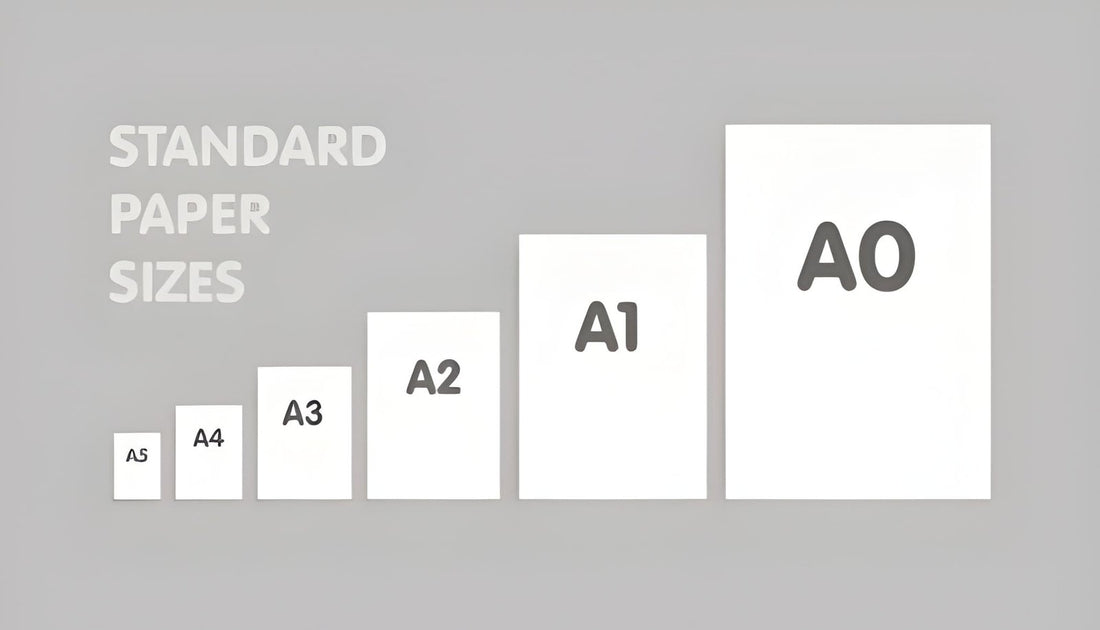
As a result, paper sizes are now governed by ISO 216, ensuring uniformity across the A series worldwide, except in the USA and Canada. The system is based on a 1:√2 aspect ratio (approximately 1:1.414), allowing each size to scale proportionally without distorting the layout. For example, enlarging A4 to A3 maintains the same proportions.
Furthermore, the largest size, A0, measures 841 × 1189 mm with an exact area of one square metre. Each subsequent paper size is created by halving the previous sheet, making the system both practical and efficient for printing and design.
A Series Paper Size Chart: A0 to A5 at a Glance
Comparing the A series paper sizes across different dimensions can help you choose the right format for your print projects.
|
Paper Size |
Dimensions (mm) |
Dimensions (cm) |
Dimensions (inches) |
|
A0 |
841 × 1,189 mm |
84.1 × 118.9 cm |
33.1 × 46.8 in |
|
A1 |
594 × 841 mm |
59.4 × 84.1 cm |
23.4 × 33.1 in |
|
A2 |
420 × 594 mm |
42.0 × 59.4 cm |
16.5 × 23.4 in |
|
A3 |
297 × 420 mm |
29.7 × 42.0 cm |
11.7 × 16.5 in |
|
A4 |
210 × 297 mm |
21.0 × 29.7 cm |
8.3 × 11.7 in |
|
A5 |
148 × 210 mm |
14.8 × 21.0 cm |
5.8 × 8.3 in |
Every A Series Paper Size and Its Applications
With the dimensions in hand, the next question is which format fits your specific project.
1. A0: The Largest Standard Sheet for Maximum Visual Impact
A0 is the largest A series paper size, designed to make a strong impression from a distance.
- Common Uses: Academic research posters, conference displays, architectural drawings, and trade show visuals.
- Best For: Large-scale presentations where viewers stand at least 1-2 metres away.
- Why Choose It: Offers maximum visual impact, ensuring detailed graphics and text remain readable even from afar.
- Typical Users: University students, architects, and event organisers presenting detailed information at conferences or exhibitions in Singapore.
2. A1: Bold Printing for Events and Exhibitions
A1 is a versatile size that provides a strong visual presence without taking up the full space of an A0 sheet.
- Common Uses: Event posters, exhibition displays, promotional signage, and retail point-of-sale materials.
- Best For: Environments with limited wall or display space but where visual impact remains essential.
- Why Choose It: Balances size and readability, making it easier to display in indoor venues.
- Typical Users: Event planners, retail marketers, and exhibitors creating engaging visuals for indoor settings.
3. A2: Versatile Printing for Retail and Campaign Posters
The A2 size, measuring 42.0 × 59.4 cm, exactly half of A1, offers a mid-range format that is readable yet compact enough for most display spaces.
- Common Uses: Promotional posters, campaign visuals, window displays, and in-store advertising.
- Best For: Retail and F&B businesses looking to display menus, seasonal campaigns, or promotional content.
- Why Choose It: Maintains a visual hierarchy without overwhelming the space.
- Typical Users: Shops, cafes, and event promoters creating attention-grabbing displays in confined areas.
4. A3: The Practical Choice for Presentations and Handouts
The A3 size, measuring 11.7 × 16.5 inches, half the dimensions of A2, provides extra space for detailed visuals and layouts.
- Common Uses: Brochures, product catalogues, presentation handouts, and infographics.
- Best For: Presentations and materials requiring clarity and additional space for graphics.
- Why Choose It: Can be folded into A4 brochures; versatile for marketing and educational materials.
- Typical Users: Corporate teams, marketing agencies, and educators preparing detailed content for print.
5. A4: The World's Most Recognised Paper Size
A4, measuring 21.0 × 29.7 cm (8.3 × 11.7 inches), is the international standard for everyday documents and the most commonly used paper size in Singapore.
- Common Uses: Flyers, business letters, office documents, brochures, reports, and general marketing collateral.
- Best For: High-volume printing, desk-based printing, and general office use.
- Why Choose It: Cost-effective, widely accessible, and compatible with nearly all printers.
- Typical Users: Businesses, schools, and individuals creating everyday documents or marketing materials.
6. A5: Compact Prints for Targeted Marketing
A5 is the smallest size in the A series guide, perfect for portable and targeted print materials.
- Common Uses: Flyers, event invitations, vouchers, handbills, and pocket-sized brochures.
- Best For: Localised campaigns and mass distribution where portability matters.
- Why Choose It: Lower per-unit printing costs while remaining effective for short-form messaging.
- Typical Users: F&B outlets, retail businesses, and event organisers running local promotions in Singapore.
How Do A Series Sizes Compare to North American Paper Sizes?
While the A series is the global standard for paper sizes, including Singapore, the USA and Canada use a different system altogether. Key North American sizes include:
- Letter (8.5 × 11 in / 215.9 × 279.4 mm): The closest equivalent to A4, but slightly wider and shorter
- Legal (8.5 × 14 in / 215.9 × 355.6 mm): Longer than A4, used for legal and government documents
- Tabloid/Ledger (11 × 17 in / 279.4 × 431.8 mm): Roughly equivalent to A3
The critical difference is aspect ratio. North American sizes do not follow the 1:√2 ratio, which means scaling designs between sizes can distort layouts.
For businesses in Singapore, the A series remains the standard, ensuring full compatibility with local printers, display frames, and venue specifications. When working with international clients or suppliers, confirm the required standard before submitting your final print files.
How to Choose the Right Paper Size for Your Print Project
When choosing a paper size for your print project, consider factors such as viewing distance, budget, and the environment where your materials will be displayed.
1. Consider Viewing Distance
Think about how and where your audience will view your print. Larger formats such as A0 and A1 are designed to capture attention from a distance; conversely, smaller formats like A4 and A5 are intended for close-up reading.
By aligning the paper size with the expected viewing distance, you ensure that your content remains clear, legible, and visually effective.
2. Factor in the Volume and Budget
Another important consideration is the scale of your print run and your budget.
Smaller paper sizes like A4 and A5 are cost-effective options for high-volume campaigns, allowing you to distribute materials widely without breaking the bank. On the other hand, A0 and A1 offer a larger visual impact per unit but come with higher production costs.
3. Check the Environment and Purpose
The location and purpose of your print materials can also help determine which size will work best. For instance, A2 to A4 fit well in indoor offices or retail displays, whereas A0 and A1 provide the visibility needed for exhibitions, outdoor events, or academic conferences.
Get Seamless Printing for Every Project with Doorstep Prints

Besides selecting the right paper size, choosing a reliable printing company such as Doorstep Prints is equally important to ensure your materials look professional and arrive on time.
We offer high-quality printing across all standard A-series sizes, from large A0 research poster printing to compact A5 flyers, with fast lead times and free delivery throughout Singapore. Whether you need large-format printing for exhibitions or conferences, or professional poster printing in Singapore, we make the process seamless, affordable, and convenient, delivering your prints directly to your doorstep.
Partner with Doorstep Prints today and see your print ideas come to life with quality and convenience!